This is default featured post 1 title

Go to Blogger edit html and find these sentences.Now replace these sentences with your own descriptions.This theme is Bloggerized by Lasantha Bandara - Premiumbloggertemplates.com.

This is default featured post 2 title

Go to Blogger edit html and find these sentences.Now replace these sentences with your own descriptions.This theme is Bloggerized by Lasantha Bandara - Premiumbloggertemplates.com.

This is default featured post 3 title

Go to Blogger edit html and find these sentences.Now replace these sentences with your own descriptions.This theme is Bloggerized by Lasantha Bandara - Premiumbloggertemplates.com.

This is default featured post 4 title

Go to Blogger edit html and find these sentences.Now replace these sentences with your own descriptions.This theme is Bloggerized by Lasantha Bandara - Premiumbloggertemplates.com.

This is default featured post 5 title

Go to Blogger edit html and find these sentences.Now replace these sentences with your own descriptions.This theme is Bloggerized by Lasantha Bandara - Premiumbloggertemplates.com.

Showing posts with label christmas. Show all posts

Thursday, December 25, 2008

Pagan History of December 25 - Jesus Christ Was NOT Born On December 25th (Christmas Day)

Did you know that Jesus Christ was not born on December 25th?

Did you know that we can prove from the Scriptures that Jesus was not born in the winter?

Did you know that there is a holiday that was instituted over a thousand years before Jesus was born that prophetically foreshadowed the circumstances of His birth?

So why do we celebrate Christmas on December 25th?

The truth is that there was a late December pagan holiday that was celebrated long before Jesus was ever born. The Roman Catholics decided to "christianize" that pagan holiday starting in 336 A.D. as a celebration of the birth of Christ. The Christian Church and much of Judaism is entrenched deep in the ancient Babylonian mystery religion, only today it is referred to as 'culture' or 'traditions.' Most Christians and Jews either don't know or care to know the truth of these pagan ties.

A recent news article from the Scripps Howard News Service states in their article, "Christmas Celebration Crosses All Faiths."
  • "Christmas remains America's favorite holiday-a religious celebration that transcends the nation's increasingly multicultural society. Eighty-three percent of the adult residents of the United States-including Jews, Muslims and atheists-say they put a decorated tree in their homes. Fifty-nine percent say there is no holiday they love more than Christmas."
What is Christmas and from where did it originate? Yule is the Chaldean name for 'infant' or 'little child.' In ancient Babylon, the 25th of December was known as Yule day or the birth of the promised child day. This was the day of the birth of the incarnate sun, who appeared as a baby child to redeem a world bound in darkness. It was an essential belief of the Babylonian religious system, that the sun god, also known as Baal, was the chief god in a polytheistic system. Tammuz was also worshipped as the god incarnate, or promised baby son of Baal, who was to be the Savior of the world.

We find in the Catholic encyclopedia that Christmas was not even among the earliest church festivals. It was not until the latter part of the fourth century that the Roman Church began observing December 25th as Jesus' birthday. By the fifth century A.D., the Roman Church ordered the birth of Messiah to be forever observed on December 25th. At the time of this decree, the Roman Church knew full well that the pagan religious cults throughout the Roman and Greek worlds celebrated the pagan sun god, Mithra, on this self same day. This winter festival was known as the Nativity of the Sun. It was also known in the Roman Empire as Saturnalia [another name for sun worship].

Note: In 46 BC, when the Roman "Julian Calendar" was adopted, December 24th was the shortest day of the year. Therefore, December 25th was the first annual day that daylight began to increase. Thus, the origin of the REBIRTH or Annual Birthday of the Invincible SUN.

In accordance with the Roman "Julian calendar," the "Saturnalia" festival appears to have taken place on December 17th; it was preceded by the "Consualia" near December 15th, and followed by the "Opalia" on December 19th. These pagan celebrations typically lasted for a week, ending just before the late Roman Imperial Festival for "Sol Invictus" (Invincible Sun) on December 25th.

In 1582 AD. Roman Catholic Pope Gregory the XIII caused the current "Gregorian Calendar" to be adopted, in order to eliminate the solar time shift error introduced by the "Julian Calendar."

By December 1582 AD the shortest day of the year had shifted 12 days on the Roman "Julian Calendar" to Wednesday, December 12, 1582.

However, the Original December 25th 'Birth Date' was retained for all pagan Sun gods by the Roman "Saturnalia" and "Sol Invictus" traditions; which were now called the "Twelve Days of Christ Mass."

On the new Roman Catholic Gregorian calendar the shortest annual day was numerically shifted back 10 days to the 22nd of December, where it remains to this day; while the original order of the days of the week remained unchanged.

Therefore, Wednesday, December 12th, 1582 AD, became Wednesday, December 22nd, 1582 AD, and the True Sabbath Day remained unchanged.

Yahweh, the Only True Self-existent Eternal Creator, would never have allowed The True Messiah to be born on or near the December 25th birthday period of the pagan Sun gods; during the time in which virgins were sacrificed, murder was commonplace, and orgies the norm. This would be an entirely unacceptable association.

The winter festival was very popular in ancient times, and marked a time of rejoicing and festivity. Much of our present day customs involved in the Christmas season are a direct inheritance of the Roman winter festival of Saturnalia. These days involved gift giving, colored lights to ward off evil spirits, festive meals, and of course, decorated trees.

The present day Christmas tree also goes back to the worship of sacred trees in the ancient Babylonian system. The green evergreen symbolized the incarnate Baal coming to life through the incarnate baby Tammuz. The custom of decorating and worshipping trees spread throughout the known world, with the variety of tree used selected according to the natural growth of each area of the world. The Druids worshipped the oak tree, the Egyptians worshipped the palm tree, while in Rome it was the fir tree.

There are at least ten references in the Bible warning that these green trees were associated with idolatry and pagan worship. Jeremiah 10:1-4 details the Israelites following the very pagan customs practiced today.
The very term, Christmas, comes from the sacred Christ-mass, where the Pope in the role of the High Priest of the mystery Babylon religion introduces the people to the concept of trans-substantiation. Using the wine and round wafers to reflect the life of Baal, the sun god, the name of Jesus replaces the ancient pagan custom. The wine and wafers are now said to be the transformation of the actual blood and body of Messiah within the person who ingests them. People, thereby, relive again and again the death and resurrection of the incarnate god.

Israelites performed this same ritual in their worship to the Queen of heaven and the incarnate god Tammuz.

Calvin, in 1550, instigated an edict concerning church holidays. A ban was passed against observing various church festivals, which included Christmas. In a tract on the necessity of reforming the church, Calvin exclaimed: "I know how difficult it is to persuade the world that Yahweh disapproves of all modes of worship not expressly sanctioned by His Word." John Knox, in the Scottish reformation, repeatedly confronted the Catholic Church, contending that true worship must be instituted by God, not derived from the traditions of men. At the heart of his argument was an appeal to Torah, especially, references to Deuteronomy 4 and 12, which states that one must not add to nor subtract from God's word.

John Knox, History of the Reformation in Scotland, 1950, Vol. 1, page 91 states the following: "That Yahweh's word damns your ceremonies it is evident; for the plain and straight commandment of Yahweh is, 'Not that thing which appears good in thy eyes, shalt thou do to the LORD thy Yahweh, but what the LORD thy Yahweh has commanded thee, that do thou; add nothing to it; diminish nothing from it.' Now unless that ye are able to prove that Yahweh has commanded your ceremonies, this His former commandment will damn both you and them."

The holidays of Christmas and Easter were banned from the Church of Scotland.
David Calderwood [1511-1651], representing the Scottish ministries, asserted in reference to Christmas and Easter: "The Judaical days had once that honor, as to be appointed by Yahweh Himself; but the anniversary days appointed by men have not like honor. This opinion of Christ's nativity on the 25th day of December was bred at Rome."

David Calderwood then exposed the Roman claims made for the 25th of December as the day of Messiah's birth. He argues that the Apostles never ordained it. He said the following: "Nay, let us utter the truth, December-Christmas is a just imitation of the December-Saturnalia of the ethnic [heathen] Romans, and so used as if Bacchus [another name for the sun god], and not Messiah, were the Yahweh of Christians."

George Gillespie [1613-1649], a premier Scottish theologian, wrote in a book published in 1637 called A Dispute Against the English Popish Ceremonies Obtruded Upon the Church of Scotland. "The holidays [reference to Christmas and Easter] take a severe beating on a number of accounts. Sacred significant ceremonies devised by man are to be reckoned among images forbidden in the second commandment in regards to worshipping idols."

It is certainly clear from all that we have read, that an end time apostasy has come upon both Jews and Gentiles. Both have strayed far from the original precepts of the faith, and there will be a heavy accounting before the LORD for this. These holidays represent only part of the great apostasy that has come upon God's people in the latter days.


Watch this video with an open mind - perhaps it is time for all of us to learn the truth.

Asatru
MandMEvangelists
Paganism/XmasHistory
Sunday, December 21, 2008

Saint Nicholas: the Truth Behind Santa Claus X of X


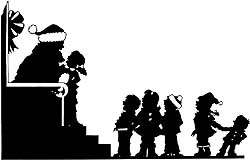
Take a trip to the local mall at Christmas time. Go watch Santa sitting on his royal throne. Kids are lined up to sit on his lap of judgement. What does Santa ask them, "Have you been a good little boy?" "Have you been a good little girl?’ Ever read Psalm 11:4?
The LORD is in his holy temple, the LORD'S throne is in heaven: his eyes behold, his eyelids try, the children of men. Psalm 11:4
There’s no question Santa is sitting on his throne. There is no question it is a mockery and pretender of the judgement of a Holy God.
And he said, Hear thou therefore the word of the LORD: I saw the LORD sitting on his throne, and all the host of heaven standing by him on his right hand and on his left. 1 King 22:19

11 And I saw a great white throne, and him that sat on it, from whose face the earth and the heaven fled away; and there was found no place for them.
12 And I saw the dead, small and great, stand before God; and the books were opened: and another book was opened, which is the book of life: and the dead were judged out of those things which were written in the books, according to their works. Revelation 20:11-12

Let us not forget the Bible says Satan has a throne.
  • For thou [Lucifer] hast said in thine heart, I will ascend into heaven, I will exalt my throne above the stars of God: I will sit also upon the mount of the congregation, in the sides of the north: Isaiah 14:13
In Acts 12, Herod is playing Santa, dressed in his Santa suit (royal apparel), on his throne, and the people saying, It is the voice of a god, and not of a man. And the angel of the Lord kills him for his blasphemy.

21 And upon a set day Herod, arrayed in royal apparel, sat upon his throne, and made an oration unto them.

22 And the people gave a shout, saying, It is the voice of a god, and not of a man.
23 And immediately the angel of the Lord smote him, because he gave not God the glory: and he was eaten of worms, and gave up the ghost.
24 But the
word of God grew and multiplied. Acts 12:21-24


He's making a list
!!!!!

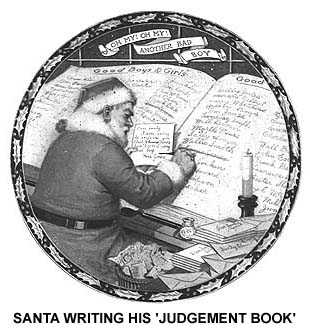
Right on schedule. . . Santa also has a list to judge who's "naughty or nice"
He's making a list, He's checking it twice
He's gonna find out Who's naughty or nice
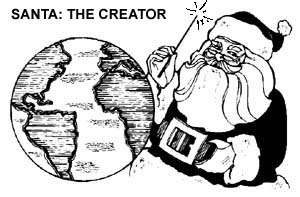
Over and over, scripture after scripture, Santa grants Satan's ultimate wish, ". . . I will be like the most High. . ."
Then they that feared the LORD spake often one to another: and the LORD hearkened, and heard it, and a book of remembrance was written before him for them that feared the LORD, and that thought upon his name. Mal. 3:16

And I saw in the right hand of him that sat on the throne a book written within and on the backside, sealed with seven seals. Rev 5:1

And I saw the dead, small and great, stand before God; and the books were opened: and another book was opened, which is the book of life: and the dead were judged out of those things which were written in the books, according to their works.
15 And whosoever was not found written in the book of life was cast into the lake of fire. Rev 20:12, 15

I wonder how many children this Christmas will be asked, "Do you BELIEVE in Santa?" I know one thing – it will be more tha n all the Christians of the world asking "Do you BELIEVE in Jesus?". Santa's witnesses will happily witness for him – faithfully, day and night – around the world. Do you really believe it’s just a coincidence that Santn (a.k.a. Satan), over and over, is counterfeiting the Lord Jesus Christ? The heart of the Christian faith is "believing" in the Lord Jesus Christ. That is the very core of the Christian faith. It is not works. It is not sacraments. It is not doing this or doing that. It is belief in the Lord Jesus Christ.
And they said, Believe on the Lord Jesus Christ, and thou shalt be saved, and thy house. Acts 16:31
Belief and faith – is the essence and heartbeat of the Christian faith. It all hinges on believing. Salvation is BELIEVING IN Jesus Christ.

"Little Boy, Little Girl, DO YOU BELIEVE IN SANTA?"

What happens when these children put so much false hope into a lie? What happens when that deceived child learns that wonderful Santa is a BIG LIE? Not only is it a false hope, not only is total deception – but it counterfeits the person of Jesus Christ! To confuse matters even worse the Lord Jesus is mixed into the lie by supposedly celebrating his birth. Tom Clancy, in his novel, The Sum of All Fears, states the lifelong disappointment and skepticism after the deception of Santa is realized:
"After you stop believing in Santa Claus,
The whole world just goes downhill."
(Tom Clancy, The Sum of All Fears, p. 481)
Who that has ever seen the Christmas classic movie The Miracle on the 34th Street can ever forget the child-like faith of young Susan Walker (played by the cute Natalie Wood). Little Susie a skeptic, who doesn't believe in Santa Claus is "converted" by the loveable Kriss Kringle (played by Edmund Gwenn). The main plot of the movie is – faith and belief in Kriss Kringle or Santa. Remember the highlight of the movie when Susan's mother, Doris (played by Maureen O'Hara) tells young Susan, " You must believe in Mr Kingle–and keep right on believing. You must have faith in him." And young Susie begins repeating over and over, "I believe, I believe. . ." Here's how the original author Valentine Davies describes the above scene:
"Susan thought it over for a moment and then began muttering with firm conviction: 'I believe, I believe, I believe–'
(Valentine Davies, Miracle on 34th Street, p. 116)
Towards the end of the movie, Santa gives Susie the "desires of her heart" and little Susie is saying, "You were right mommy, I do believe. I do believe. Mr Kingle is Santa Claus." Wow! It is also worth mentioning what Santa gives to Susan. Not the typical child's gift of a doll, etc. But a house. . . . Sound familiar?
In my Father's house are many mansions: if it were not so, I would have told you. I go to prepare a place for you. John 14:2
The movie ends as Santa (Kriss Kringle) "prepares a place" for little Susie. And they surprisingly see Santa's cane standing in the corner showing he had been there and did indeed – "prepare a place" for little Susie. By the way, did you notice the shape of Santa's cane standing in the corner? It looks like a "shepherd's" hook? Hmmm. . . Who was it that said, "I am the good shepherd. . ."? (Hint. see John 10:11) Some reviewers wrote about The Miracle on 34th Street:
"I guess the reason I, and all the other reviewers, think this film is so great is that it brings back the time when we could 'believe in Santa Claus.'"
Who has ever seen "Miracle on 34th Street" can ever forget cute, little "Natalie Wood" says "when things don't turn out just right you still have to believe, and oh mommy I do believe, I do."
Another reviewer writes, ". . . this is a beautiful movie, that can make anyone believe in Santa Claus."
The name of the movie is The MIRACLE on 34th Street. Now who is it that does miracles?
This beginning of miracles did Jesus in Cana of Galilee, and manifested forth his glory; and his disciples believed on him. John 2:11

"Ho! Ho! Ho! I Am God".
In 1994, the satire magazine The Onion carried a parody of Santa Claus titled "Ho! Ho! Ho! I Am God". Even though, it was written as a blasphemous parody much truth rings from the article. The article says:
"I love visiting each and every one of your homes, stuffing your stockings with toys, and enjoying the milk and cookies you leave for me. But mostly I love Christmas because it's the celebration of the birth of my son, Jesus the Christ. You see, I'm God. . . Don't I look familiar? I'm old, I have a white beard, I love everyone. I'm the same God as the one you and your mommy and daddy worship on Sundays. . .

Okay, I admit it. I'm not God. But I'm better than God. I'm jollier, and I give you real toys, not boring old psalms and empty promises you can only collect on when you die. Worship me, not Him! Worship Santa! I am God!"
(Santa Claus, "Ho! Ho! Ho! I Am God!" The Onion, 29 Nov. - 5 Dec., 1994, p. 7)

And that is EXACTLY the message being preached to these little children! And they believe it!

You have to be blind to not see the possible connection. And you have to be spiritually blind to not see the possible spiritual damage such a massive, false-faith, God-like, LIE is doing to the faith and trust of that young child.


Friday, December 19, 2008

Saint Nicholas: the Truth Behind Santa Claus IX of X


Santa is All-Powerful – He is Omnipotent

To the average child - Santa can do anything. The following are actual letters to Santa from children, taken from a local newspaper. Read these letters and look at the faith these children have in their god: (Knox 6)
"Dear Santa. . . If I could have one Christmas wish, it would be for my mom to get better. She has bad arthritis. Would you please heal her?"

"Dear Santa. . . For Christmas would you please give humanity a cure for cancer and a cure for AIDS, and would you please give us a new solar system where people live right?"

"Dear Santa. . . My mom and I both have disabilities. Would you please give both of us new bodies?"

"Dear Santa. . . Please bring peace on earth."

Is anything too hard for Santa?
Is anything too hard for the LORD? Genesis 18:14

And Jesus came and spake unto them, saying, All power is given unto me in heaven and in earth. Matthew 28:18

Come rain, sleet, snow, storm, hurricane, the darkest and dreariest of nights – Santa comes. Their Santa NEVER fails! In one night, the all-powerful, Santa delivers millions and millions of gifts to children all around the world. Who could do that? Now, who REALLY believes that? That little child who has been preached to about Santa. That is who. They believe it. Just ask one. Nothing is too hard for their Santa. If the Christian world had, even a small drop of the faith the average child has in Santa – we’d have revival overnight!

These little kids believe and have more faith in their Santa than all the Christians of the world. If the Christians of the world could just catch a spark of that faith these kids have in Santa – we would have a world-wide revival. Have you ever considered how unbelievable and powerful Santa is? The scientific journal SPY magazine (January 1990) constructed a scientific analysis of Santa. Here’s some of there conclusions:
Santa has 31 hours of Christmas to work with, thanks to the different time zones and the rotation of the earth, assuming he travels east to west (which seems logical). This works out to 822.6 visits per second. This is to say that for each house, Santa has 1/1000th of a second to park, hop out of the sleigh, jump down the chimney, fill the stockings, distribute the remaining presents under the tree, eat whatever snacks have been left, get back up the chimney, get back into the sleigh and move on to the next house.

. . . a total trip of 75-1/2 million miles, not counting stops to do what most of us must do at least once every 31 hours, plus feeding and etc. This means that Santa's sleigh is moving at 650 miles per second, 3,000 times the speed of sound.

The payload on the sleigh adds another interesting element. Assuming that each child gets nothing more than a medium-sized lego set (2 pounds), the sleigh is carrying 321,300 tons.

This increases the payload - not even counting the weight of the sleigh - to 353,430 tons. 353,000 tons traveling at 650 miles per second creates enormous air resistance - The lead pair of reindeer will absorb 14.3 QUINTILLION joules [jewels-measurement of energy] of energy. Per second.

In short, they will burst into flame almost instantaneously and create deafening sonic booms in their wake. The entire reindeer team will be vaporized within 4.26 thousandths of a second. Santa, meanwhile, will be subjected to centrifugal forces 17,500.06 times greater than gravity. A 250-pound Santa (which seems ludicrously slim) would be pinned to the back of his sleigh by 4,315,015 pounds of force.
(SPY Magazine, January 1990)

In a moment, in the twinkling of an eye. . ." (1 Cor. 15:52) – Santa appears – all over the world! He just quietly "tip-toes" in – and "tip-toes" out. You hear nothing. You see nothing. He appears like a "thief in the night". (1 Thess. 5:2). And we expect our children to believe in a supernatural being that can do all that? And you know what – THEY DO! And they believe it with all their little heart, soul and mind!
35 Then one of them, which was a lawyer, asked him a question, tempting him, and saying,
36 Master, which is the great commandment in the law?
37 Jesus said unto him, Thou shalt love the Lord thy God with all thy heart, and with all thy soul, and with all thy mind.
38 This is the first and great commandment.
Matthew 22:35-38


Where did Santa come from? How did Santa get here? When did Santa magically appear? Like, Melchisedec (which most Bible students believe to be a reference to the incarnate Jesus Christ), Santa Claus is like the Son of God: "Without father, without mother, without descent, having neither beginning of days, nor end of life; but made like unto the Son of God;. . ." Hebrews 7:3 Santa is from everlasting to everlasting. His "years are throughout all generations". Possessing the attribute of an eternal God, Santa ". . . thou art the same, and thy years shall have no end." He has no beginning. He has no end. Like God Almighty, Santa is eternal. The famous editorial, Yes, Virginia There is a Santa Claus, written by Francis P. Church and published in The New York Sun on September 21, 1897 to 8-year-old Virginia O'Hanlon, ends with the following words:
"No Santa Claus! Thank God, he lives, and he lives forever. A thousand years from now, Virginia, nay, ten times ten thousand years from now, he will continue to make glad the heart of childhood."
(Francis P. Church Yes, Virginia There is a Santa Claus, The New York Sun, September 21, 1897)
1 The LORD reigneth, he is clothed with majesty; the LORD is clothed with strength, wherewith he hath girded himself: the world also is stablished, that it cannot be moved.
2 Thy throne is established of old: thou art from everlasting. Psalm 93:1-2

Art thou not from everlasting, O LORD my God, mine Holy One? we shall not die. O LORD, thou hast ordained them for judgment; and, O mighty God, thou hast established them for correction. Habakkuk 1:12

24 I said, O my God, take me not away in the midst of my days: thy years are throughout all generations.
25 Of old hast thou laid the foundation of the earth: and the heavens are the work of thy hands.
26 They shall perish, but thou shalt endure: yea, all of them shall wax old like a garment; as a vesture shalt thou change them, and they shall be changed:
27 But thou art the same, and thy years shall have no end. Psalm 102:24-27


The Christmas "Spirit"? And yes, Santa has his own "spirit." The "Spirit of Christmas." Isn’t that a little strange? Gene Autry’s famous song "Here Comes Santa Claus" begins with the words, "Speakin' of Christmas spirit." Ring a bell? . . .
16 And I will pray the Father, and he shall give you another Comforter, that he may abide with you for ever;
17 Even the Spirit of truth; whom the world cannot receive, because it seeth him not, neither knoweth him: but ye know him; for he dwelleth with you, and shall be in you. John 14:16-17 I wonder what John thinks of the "spirit of Christmas"?

1 Beloved, believe not every spirit, but try the spirits whether they are of God: because many false prophets are gone out into the world.
2 Hereby know ye the Spirit of God: Every spirit that confesseth that Jesus Christ is come in the flesh is of God:
3 And every spirit that confesseth not that Jesus Christ is come in the flesh is not of God: and this is that spirit of antichrist, whereof ye have heard that it should come; and even now already is it in the world. 1 John 4:1-3

SANTA

You better watch out,
You better not cry
You better not pout,
I'm telling you why Santa Claus is comin' to town
He's making a list,
He's checking it twice
He's gonna find out
Who's naughty or nice
Children the world over are taught to FEAR Santa. You’d better go to bed little boy – Santa is watching. Millions of fearful children are told, "You’d better behave. Santa is watching. You might not get anything for Christmas."

The fear of the Lord is the "beginning" of the Christian faith. And the fear of Santa is the beginning of the Santa faith – and possibly the destruction of their Christian faith!
The fear of the LORD is the beginning of wisdom:. . . Psalms 111:10
While our children should be taught the fear of the Lord, most are taught the sacrilegious fear of the false god of Santa.
Come, ye children, hearken unto me: I will teach you the fear of the LORD. Psalm 34:11

Friday, November 28, 2008

Saint Nicholas: the Truth Behind Santa Claus III of X

The truth about the origin of Santa Claus.

Something else that fashioned our modern day Santa was the popular medieval Christmas plays of the tenth through the sixteenth century. These miracle, moral, mystery and passion dramas acted out scenes from the scriptures and the liturgy of the Roman Catholic Church. Combining humor and religion, they flourished during the fifteenth century. It is significant that St. Nicholas was a dominant theme among these plays. Much of the myth and outlandish miracles of St. Nicholas originated from these dramas. And much of the bizarre characteristics of Santa were planted in these Christmas plays.

In the classic, Teutonic Mythology, author Jacob Grimm provides us with some revealing detail into St, Nicholas’s transformation into Santa. Notice in the following excerpt from Teutonic Mythology where Nicholas converts himself into the Knecht Ruprecht, a "man of Clobes" or a "man of Claus." Grimm states, the characters of Nicholas and Knecht Ruprecht "get mixed, and Clobes [Claus] himself is the "man."

The Christmas plays sometimes present the Saviour with His usual attendant Peter or else with Niclas [St. Nicholas]. At other times however Mary with Gabriel, or with her aged Joseph, who, disguised as a peasant, acts the part of Knecht Ruprecht Nicholas again has converted himself into a "man Clobes" or Rupert; as a rule there is still a Niclas, a saintly bishop and benevolent being distinct from the "man" who scares children; the characters get mixed, and Clobes himself acts the "man." (qtd. in Siefker, Phyllis. Santa Claus, Last of the Wild Men: The Origins and Evolution of Saint Nicholas. Jefferson: McFarland & Company, Inc., 1997, p. 69)

From Grimm’s account, in the early 1100’s, the transformation of St. Nicholas into Santa Claus from the devil Knecht Ruprecht was in full throttle.There is not enough space in this book to adequately document the influence and inspiration of the medieval plays into the making of Santa, but let us examine Santa’s trademark "Ho! Ho! Ho!". Most people have no idea where this came from, and more important whom it came from. . .

In The Drama Before Shakespeare - A Sketch, author Frank Ireson, describes the popular Miracle Play. Notice the description of the devil as "shaggy, hairy," etc. (as Santa), and notice the devil’s trademark "exclamation on entering was ho, ho, ho!":

Besides allegorical personages, there were two standing characters very prominent in Moral Plays—the Devil and Vice. The Devil was, no doubt, introduced from the Miracle Plays, where he had figured so amusingly; he was made as hideous as possible by his mask and dress, the latter being generally of a shaggy and hairy character, and he was duly provided with a tail: his ordinary exclamation on entering was, "Ho, ho, ho! what a felowe [sic] am I."(Ireson, Frank. "The Drama Before Shakespeare - A Sketch." 1920 ) In these plays, the devil’s common entry line, known as the "devil’s bluster," was "Ho! Ho! Hoh!"(Siefker, Phyllis. Santa Claus, Last of the Wild Men: The Origins and Evolution of Saint Nicholas. Jefferson: McFarland & Company, Inc., 1997, p. 69)

The devil’s trademark "ho, ho, ho" was carried over from the early medieval Miracle Plays to the popular old English play "Bomelio," as the following lines from the play verify:

What, and a' come? I conjure thee, foul spirit, down to hell! Ho, ho, ho! the devil, the devil! A-comes, a-comes, a-comes upon me,. . . (Dodsley, Robert. A Select Collection of Old English Plays, Vol. VI. The Project Gutenberg Ebook. )

Another extremely popular character dominating the medieval plays was Robin Goodfellow (Robin Hood was created from him). Robin Goodfellow was a caricature of the devil, dressed with horns, shaggy, furs, and cloven feet.

Author Gillian Mary Edwards in Hobgoblin and Sweet Puck, provides some interesting insight into Robin Goodfellow:

One of the most popular characters in English folklore of the last thousand year
s has been the faerie, goblin, devil or imp known by the name of Puck or Robin Goodfellow. The Welsh called him Pwca, which is pronounced the same as his Irish incarnation Phouka, Pooka or Puca. Parallel words exist in many ancient languages - puca in Old English, puki in Old Norse, puke in Swedish, puge in Danish, puks in Low German, pukis in Latvia and Lithuania – mostly with the original meaning of a demon, devil or evil and malignant spirit. . . (Edwards, Gillian Mary. Hobgoblin and Sweet Puck. London: Bles Publishers, 1974, p. 143)

In The History of a Hobgoblin, author Allen W. Wright, reveals "Robin itself was a medieval nickname for the devil" and "Robin's trademark laugh is "Ho Ho Ho!":

Robin Goodfellow appeared in more plays around 1600. And there were many 17th century broadside ballads about him. . . Robin's trademark laugh is "Ho Ho Ho!" . . . Robin itself was a medieval nickname for the devil. (Wright, Allen W. "The History of a Hobgoblin." )

The original author is hidden today, but the devil’s trademark "Ho! Ho! Ho!" was common knowledge before the coming of Santa Claus.

Author Tony Renterghem, concludes his extensive research into the origin of Santa with the following statement:

I can only conclude that the original ancestor of our modern Santa Claus is none other than the mythological Dark Helper-a faint memory of Herne/Pan, the ancient shamanic nature spirit of the Olde Religion. (Renterghem, Tony van. When Santa Was a Shaman. St. Paul: Llewellyn Publications, 1995, p. 93)

Note: Herne or Pan is the horned god. It is common knowledge that Pan and Herne are popular names for Satan. The Satanic Bible lists Pan as one of the Infernal Names of Satan. (LaVey, Anton Szandor. The Satanic Bible. New York: Avon Books, Inc., 1969 p. 144)

After researching scores of books and material on the origin of Santa Claus, by far, the best book on this subject is Santa Claus, Last of the Wild Men: The Origins and Evolution of Saint Nicholas, authored by the late University of Kansas associate, Phyllis Siefker. This is no child’s book, but a scholarly exploration into the origin of Santa Claus. It is published by the prestigious McFarland Publishers, a leading publisher of reference and academic books. This book carries no Christian bias, but is simply a secular, non Christian scholastic study. With that in mind, the following analysis by Siefkler is even more alarming:

The fact is that Santa and Satan are alter egos, brothers; they have the same origin. . . On the surface, the two figures are polar opposites, but underneath they share the same parent, and both retain many of the old symbols associated with their "father" . . . From these two paths, he arrived at both the warmth of our fireplace and in the flames of hell. (Siefker, Phyllis. Santa Claus, Last of the Wild Men: The Origins and Evolution of Saint Nicholas. Jefferson: McFarland & Company, Inc., 1997, p. 6)

Next we shall examine Santa in the light of the Word of God.


Friday, November 14, 2008

THE TRUTH BEHIND CHRISTMAS

THE TRUTH ABOUT CHRISTMAS

Most professing Christians believe that Christmas is one of the most important holidays. without question, many people blindly follow its observance. Moreover, they assume that Jesus was actually born on December 25. Because we look to Christ as our Savior, it is important to take a deeper look into his birth. We often hear people say, "Let's put Christ back into Christmas!" Perhaps we should investigate just how Christ got into Christmas in the first place.

Most Bible scholars agree that Christmas is of pagan origin. In his book 4000 Years of Christmas, Earl W. Count, Professor of Anthropology at Hamilton College, explains the origin of the Christmas celebration:

"We do not know its beginning . . . we do not really know when the Christ child it venerates was born: or the time and place when Christmas was first celebrated: or exactly how it was that, over the centuries, a bishop saint of Asia Minor, and a pagan god of the Germans merged to become Santa Claus."

"although the Christmas story centers in the Christ child of Bethlehem, it begins so long before his coming that we find its hero arriving on the scene after more than half of the time of the story has gone by. Christmas began over 4000 years ago, as the festival which renewed the world for another year. The 12 days of Christmas, the bright fires and probably the yule log; the giving of presents; the carnivals with their floats; their merry makings and clowning; the mummers who sing and play from house to house, the feasting; the church processions with their lights and song —all these and more began three centuries before Christ was born. And they celebrated the arrival of a new year" (ibid., page 18).

"For that day [25 of December] was sacred, not only to the pagan Romans but to a religion from Persia which, in those days, was one of Christianity's strongest rivals. This Persian religion was Mithraism, whose followers worshiped the sun, and celebrated its return to strength on that day. The church finally succeeded in taking the merriment, the greenery, the lights, and gifts from Saturn and giving them to the "babe of Bethlehem" (ibid., page 27).

Mosaic of Jesus Christ depicted as Sol, a Sun god, in Mausoleum M in the pre-fourth-century necropolis under St Peter's Basilica in Rome. It is named Christo Sole (Christ the Sun) and is dated to the late 3rd century by the Italian archaeologists

"It happened that the date [December 25] did fall in the midst of the Saturnalia. Far from being an invention to compete against Roman and Persian paganism, the birthday of Christ ran the danger of being swallowed up in pagan merry making. The [church] fathers tried strenuously to keep Christmas strictly a churchly celebration. It was part of their unremitting struggle to break the grip of the pagan gods upon the people. And as they broke, Romans became Christians . . . but the Saturnalia remained" (ibid., page 28).

In Rome, the Winter Solstice was celebrated many years before the birth of Christ. The Romans called their winter holiday Saturnalia, honoring Saturn, the God of Agriculture. In January, they observed the Kalends of January, which represented the triumph of life over death. This whole season was called Dies Natalis Invicti Solis, the Birthday of the Unconquered Sun. The festival season was marked by much merrymaking. It is in ancient Rome that the tradition of the Mummers was born. The Mummers were groups of costumed singers and dancers who traveled from house to house entertaining their neighbors. From this, the Christmas tradition of caroling was born.


"When was Jesus born? No one knows. December 25 is no more than the historical date of his birth than is any other" [page 50]. "Christmas, as we have seen, is of the Mediterranean . . .for the Mediterranean world already had not merely centuries, but millennia behind it, when Christ was born; and even the religion which he founded had traveled several centuries before it discovered its need of Christmas" (page 86).

"Renewal and rebirth: After 4000 years, the festival that has grown about the birth of the Christ child remains an affirmation that all things can be made anew" (ibid., page 91).

although no one knows the exact date of Christ's birth, there is evidence that he was not born in the winter: "And there were in the same country shepherds abiding in the field, keeping watch over their flocks by night" (Lk.2:8). This never could have occurred in the month of December in Palestine. The shepherds usually brought their flocks from the mountainsides and fields and corralled them no later than the middle of October to protect them from the cold, rainy season that followed. The Song of Solomon 2:11 and Ezra.10:9, 13 show that winter was a rainy season during which shepherds could not have remained in open fields at night:

"It was an ancient custom among the Jews of those days to send their sheep to the fields, and deserts about Passover [early spring] and bring them home at commencement of the first rain . . .During the time they were out, the shepherds watched them night and day, . . .The first rains began early in the month of Marchesvan, which answers to part of our October and November [begins in the middle of October] we find that the sheep were kept out in the open country during the whole summer, and as these shepherds had not yet brought home their flocks, it is a presumptive argument that October had not yet commenced, and that consequently, our Lord was not born on the 25 of December, when no flocks were out in the fields by night. On this very ground, the nativity in December should be given up. The feeding of the flocks by night in the fields is a chronological fact" (The Adam Clarke Commentary, Volume 5, page 347).

The Birthday of the Ligth of the World - PDF

There is no command in the whole Bible that tells us to observe Christmas. Under the inspired teaching of Paul and Peter and the other apostles, the Christians of the first century never observed Christ's birth date. Christmas came to us through the Roman Catholic Church, which is where it gets its authority as a religious holiday. According to the Catholic Encyclopedia, which is published by the Catholic Church: "Christmas was not among the earliest festivals of the church . . .The first evidence of the feast is from Egypt. "We find this truth acknowledged further in the Encyclopedia Britannica: "Christmas [i.e., the Mass of Christ] was not among the earliest festivals of the church."

The Encyclopedia Americana states:

"Christmas, . . .it was, according to many authorities, not celebrated in the first centuries of the Christian church, as the Christian's usage in general was to celebrate the death of remarkable persons rather than their birth . . ." (The communion, which is instituted by New Testament authority, is a memorial of the death of Christ.) ". . .A feast was established in memory of this event (Christ's birth) in the fourth century. In the fifth century, the Western church ordered it to be celebrated forever on the day of the old Roman feast of the birth of Sol, as no certain knowledge of the day of Christ's birth existed."

How did the pagan custom get into the church? Most recognized authorities agree that Christmas was not observed by the early church for the first two or three hundred years and that its origin began in the western segment of the Roman Church in the fourth century A.D.. However, it was not until the fifth century that the Roman Church ordered it to be celebrated as an official Christian festival.

The Schaff-Herzog Encyclopedia:

"How much the date of the festival depended upon the pagan Brumalia (December 25) following the Saturnalia (December 17-24), and celebrating the shortest day of the year and the "new sun " . . .cannot be accurately determined. The pagan Saturnalia and Brumalia were too deeply entrenched in popular custom to be set aside by Christian influence. The pagan festival with its riot and merrymaking was so popular that Christians were glad of an excuse to continue its celebration with little change in spirit and manner. Christian teachers of the West and Near East protested against the unseemly frivolity, while Christians of Mesopotamia accused their western brethren of idolatry and sun worship for adopting as Christian the pagan festival."

"The observance of December 25 (as a Christian festival) only dates from the fourth century and is due to assimilation with the Mithraic festival of the birth of the sun" (World Popular Encyclopedia, Volume 3).

"Gradually a number of prevailing practices of the [heathen] nations into which Christ came were assimilated and were combined with the religious ceremonies surrounding Christmas. The assimilation of such practices generally represented efforts by Christians to transform or absorb otherwise pagan practices" (The Zonderian Pictorial Encyclopedia of the Bible, Volume 1, page 805).

"The pagan symbolism was taken over and, in Christian view, elevated. Jesus became the "sun of justice" and the "sun of righteousness" (Celebrations: The Complete Book of American Holidays, Myers, page 310).

"Our annual Christian festival (Christmas) is nothing but a continuation under a different name of this old solar festivity (Saturnalia)" (The New Golden Bough, Frazer and Foster, page 653).

"Christmas was generally celebrated in the West only after the triumph of Constantine when the time of Christ's birth was reckoned with the Day of the Unconquered Sun on 25 December" (From Christ to Constantine, Smith, pages 150-151).

"The assimilation of Christ to the sun god, as sun of righteousness, was widespread in the fourth century and was furthered by Constantine's legislation on Sunday, which is not unrelated to the fact that the sun god was the titular divinity of his family" (A History of the Christian Church: Revised, Walker, Section 13, pages 154-155).

The Myth of Nimrod

Nimrod, the grandson of Ham and the great grandson of Noah, was the real founder of the Babylonian system of worship and government that continues to thrive throughout the world.

Ancient writings speak of Nimrod as the one who started a great, organized world apostasy against God, which still dominates the world. It is said that he was so wicked that he married his own mother, Semiramis. After Nimrod was killed, his mother-wife propagated the doctrine of the survival of Nimrod as a spirit-being. She claimed that a full grown evergreen tree sprang up overnight from a dead tree stump which symbolized the resurrection of Nimrod. On each anniversary of his birth (supposedly December 25), she claimed Nimrod would visit the evergreen tree and leave gifts upon it.


Mother and Child Theme

Through her scheming and planning, Semiramis became the Babylonian Queen of Heaven, and Nimrod, under many other names, became the Divine Son of Heaven. Through the generations, in this idolatrous worship, Nimrod also became the false messiah, son of Baal, who was the sun-god. In this false Babylonian religious system, the mother and child (Semiramis and the reborn Nimrod) became chief objects of worship. This worship of mother and child spread throughout the world. Only the names varied because of differing languages. In Asia they were known as Cybele and Diorus. In Rome they were Fortuna and Jupiter. In Egypt their names were Isis and Osiris. Long before the birth of Jesus Christ, the counterpart of the Madonna can be found throughout China, Tibet, and Japan.

The following are explanations of the origins of popular practices and symbols of the Christmas celebration.

Yule Logs

The yule log is in reality the sun log. Yule means wheel, which is applied as the pagan symbol of the sun. Today, professing Christians speak of the sacred yuletide season. There is nothing sacred about it! The symbols come from the worship of false gods.

The Christmas Tree

The Christmas tree was equally common in pagan Rome and pagan Egypt.In Egypt that tree was the palm tree and in Rome it was the fir tree. The palm tree denotes the pagan messiah, Baal-Tamar (Jdg.20:33), and the fir tree denotes the same pagan messiah under the name Baal-Berith. The mother of Adonis, the sun god and great divine mediator, was said to have been mystically changed into a tree. And when she was in that state, she brought forth her divine son.

Mistletoe

"That mistletoe bough in the Druidic superstition, which was derived from Babylon, was a representative of the Messiah, "the man of the branch." The mistletoe was regarded as a divine branch, a branch that came from heaven, and grew upon a tree that sprang out of the earth. Thus by engrafting the celestial branch into the earthly tree, heaven and earth, which sin had severed, were joined together. Thus the mistletoe bough became the token of divine reconciliation to man, the kiss being the well known token of pardon and reconciliation" (The Two Babylons, Hislop, page 99).

The Encyclopedia Americana says:

"The holly, the mistletoe and the yule log . . . are relics of pre-Christian times."

Gifts

Many exchange gifts because the three wise men presented gifts to the Christ child. Did you know the Bible nowhere states there were three wise men? Did you know those wise men never appeared at the manger on Christ's birth night; they actually arrived many months later? They didn't appear at the manger, they appeared at Christ's house (Matt. 2:11).

although most people believe that the custom of giving gifts at Christmas is associated with the men that brought gifts to the child Jesus, the New Standard Encyclopedia, Christmas, says:

"In reality, at least so far as the English speaking people are concerned, it [gift giving at Christmas] is derived from an old heathen custom."

"The wise men gave their gifts to Christ, but did not exchange gifts with each other. The gifts presented to Christ were to a king, because of his royalty, and not because of his birthday. He was a king, and the people of the East never approached the presence of a king without a present in their hands" (Adam Clarke Commentary, Volume 5, Matt. 2:11, page 34).

The Christmas Wreath

The use of Christmas wreaths is believed by authorities to be traceable to the pagan customs of decorating buildings and places of worship at the feast which took place at the same time as Christmas. The Christmas tree is from Egypt and its origin dates from a period long anterior to the Christmas era(Answers to Questions, Frederick gentlemen. Haskins).

Christmas and many other holidays have come directly from paganism, but the annual observances and festivals of Leviticus 23 have come from God and should be observed today by the children of God. See our study papers about the annual festivals and commanded observances of God.

Santa Claus

The name Santa Claus is actually the corruption of the name St. Nicholas, a Roman Catholic bishop who lived in the fifth century.

St. Nicholas, Bishop of Myra. . .a saint honored by the Greeks and Latins on the 6th of December. . .a legend of his surreptitious bestowal of dowries on the three daughters of an impoverished citizen. . .is said to have originated the old custom of giving presents in secret on the eve of St. Nicholas (December 6) subsequently of Christmas and Santa Claus"(Encyclopedia Brittanica, 11th Edition, Volume 19, pp. 648-649).

Kris Kringle

“From the German people were to come those most universal of Christmas customs: the Christmas tree, and the portly beneficent Kris Kringle, known as Santa Claus.

Gradually the Presbyterians, Quakers and Puritans accepted such customs as the Christmas tree, the giving of small gifts and the Christmas feast. But they spoke violently against the corruption of the Christkindl, (the Christ Child) into Kris Kringle. After Kris Kringle was fully assimilated, there was much concern among all religious groups about the non-religious trend of the holiday”(Christmas Day: The Complete Book of American Holidays, Myers, pp. 314-316).

SUMMARY

Easter, Halloween, and Christmas are the three major religious celebrations of professing Christianity today. And all three violate the instructions of God concerning false Gods and false religious practices.

There are many holidays that are national or local in origin and are not forbidden in the Biblical record (e.g., Thanksgiving Day, Mother's Day, Father's Day). If a holiday does not violate God's law and is merely an observances of respect, honor, or gratitude, no spiritual issue is in question. However, if a person chooses to incorporate these days as part of their worship of God, there is an obvious violation of God's law.

The scriptures clearly record that the only worship acceptable to God is worship that conforms to his instructions concerning how he wants to be worshiped. Moreover, God's law imposes the death penalty on all who improperly worship him.